Precision CFD Trading in Switzerland: Exploiting Volatility Across the SMI and Mid-Cap Equities


Switzerland is often associated with stability—its banking system, political neutrality, and reputation as a safe haven for investors. Yet, beneath that calm exterior lies a vibrant equity market where volatility creates opportunities for traders who know how to navigate it.
CFDs have become an increasingly popular instrument in this landscape, enabling traders to capitalise on short-term price movements across indices like the Swiss Market Index (SMI) and a wide spectrum of mid-cap equities.
For those aiming to trade with precision, the Swiss market offers both challenges and rewards. The key lies in understanding how to harness volatility without being overwhelmed by it.
CFDs and the Precision Mindset
At its core, CFD trading is about precision. Because CFDs are leveraged products, small price movements can translate into significant gains or losses. Swiss traders who thrive in this environment often share certain traits: disciplined risk management, a deep understanding of their chosen assets, and the ability to act quickly in response to shifting market signals.
The appeal of CFDs in Switzerland is also practical. Traders can speculate on both rising and falling markets, an essential feature in a country where equity valuations can swing rapidly based on global trade dynamics, the strength of the Swiss franc, or regulatory developments in industries like pharmaceuticals and banking.
For a CFD trader suisse, the combination of advanced platforms, competitive spreads, and access to diverse assets makes this approach not just possible but potentially rewarding. CFDs provide the flexibility to move beyond traditional buy-and-hold strategies, aligning better with the fast-paced nature of today’s markets.
Exploiting Volatility in the SMI
Trading the SMI through CFDs requires a keen eye on macroeconomic indicators. Swiss blue-chip stocks often react sharply to global economic data, central bank policy, and currency fluctuations. For example, an appreciation in the Swiss franc may weigh on export-heavy firms like Nestlé, creating downward pressure on the SMI. Conversely, signs of global economic recovery can trigger rallies across the index.
Volatility here tends to be less erratic than in mid-cap markets, but opportunities still exist for traders with a clear plan. Many CFD traders use technical analysis—support and resistance levels, trendlines, or moving averages—to time entries and exits. Others combine these tools with fundamental triggers, such as quarterly earnings or geopolitical developments, to enhance precision.
Mid-Cap Equities: Higher Risk, Higher Reward
Mid-cap equities in Switzerland bring a different flavour of volatility. These companies often serve niche markets or are leaders in specific sectors like luxury goods, speciality chemicals, or industrial machinery. While less globally dominant, they can react dramatically to local developments, changes in consumer demand, or innovation within their industries.
CFDs allow traders to engage with these equities without the need to own the underlying shares, which can be less liquid or carry higher transaction costs. A mid-cap stock that experiences a sudden surge in demand could provide an attractive long-term opportunity, while disappointing results might create potential for short selling.
The challenge lies in managing the sharper swings. Effective strategies often include tighter stop-loss placements, diversified positions across multiple sectors, and constant monitoring of news sources that impact smaller firms. For traders who thrive on action, the mid-cap arena can deliver.
Risk Management: The Foundation of Precision
Regardless of whether one trades the SMI or mid-cap equities, risk management is the cornerstone of successful CFD trading. Leverage amplifies both profits and losses, making it essential to approach every position with discipline.
Swiss traders often rely on techniques such as:
- Position sizing to ensure no single trade jeopardizes overall capital.
- Stop-loss orders to protect against sudden market reversals.
- Hedging positions when exposure to correlated assets creates concentration risk.
Moreover, emotional discipline is critical. Volatility can tempt traders into overtrading, but precision requires restraint and a long-term mindset. The best traders view risk management not as a safety net but as an integral part of their strategy.
Building a Strategy That Fits the Swiss Market
The Swiss equity landscape demands a tailored approach. For some traders, focusing on the SMI provides enough depth and liquidity to develop consistent strategies. Others may prefer the dynamism of mid-caps, accepting higher risk in exchange for potential outperformance. A balanced approach often combines both, using CFDs to adapt positions quickly as market conditions evolve.
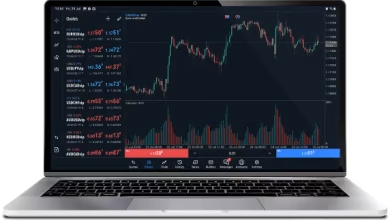
Technology also plays a crucial role. Advanced trading platforms now offer real-time data, sophisticated charting tools, and seamless execution—all indispensable for precision trading. Education is equally important, as understanding both the mechanics of CFDs and the specific drivers of the Swiss market can mean the difference between consistency and frustration.
Conclusion
Switzerland’s reputation for stability makes its markets uniquely intriguing for CFD traders. Beneath the surface, volatility across the SMI and mid-cap equities provides fertile ground for those equipped with precision, discipline, and strategic insight. CFDs act as the bridge between opportunity and execution, allowing traders to engage with both predictable large-cap movements and the more volatile swings of mid-cap stocks.
For Swiss traders willing to embrace volatility without being consumed by it, the path forward is clear: combine rigorous analysis with disciplined risk management, stay adaptable, and view each fluctuation not as a threat, but as a chance to act with confidence.